Next week marks the beginning of an extensive seminar on clinical structures in psychoanalysis, a collaboration with Theory Underground. I am very excited about this project, which is designed to distinguish itself both in form and content. I am particularly looking forward to working closely with Dave from Theory Underground. Dave will be assisting me during the sessions and will occasionally offer his commentary, enriching our discussions.
Our seminar will delve into the specificities of neurosis, psychosis and autism in Freud and Lacan’s psychoanalysis. We will discuss their clinical importance, how they differ and relate to each other, and the idea of a unique autistic structure? The seminar will engage with these psychoanalytic questions and contrast them with the history of their psychological and normative accounts today.
Each session includes a lecture, discussion, and in-class readings. No prior knowledge of Lacan’s teachings is required. Wednesday evening for the next months or so.
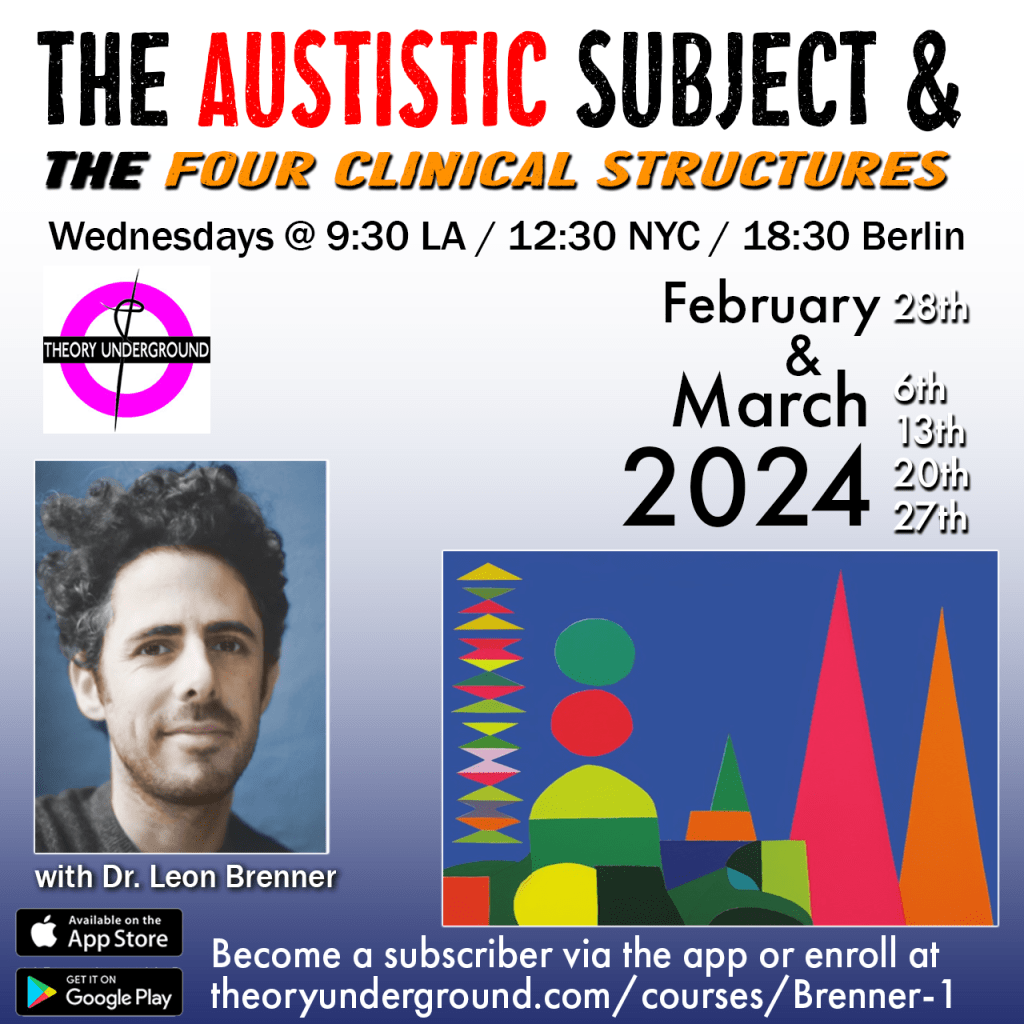
Theory Underground is an educational platform created for working-class intellectuals and unconventional academics eager to grasp the complexities of our current circumstances. It strives to offer opportunities that many have missed out on in university settings—whether due to not attending or the lack of quality content related to their interests. Within their app, users can access a variety of resources, including introductory and in-depth courses, monthly research seminars, and weekly TU HUB events. These events feature office hours, writing workshops, multilingual immersion clubs, and the TU film club, providing a comprehensive suite of tools for intellectual and creative engagement.
Rough sketch of the course:
Session 1 (28.2): Repression as a Key Aspect of the Subject
We’ll discuss Freud’s view that repression is central to all psychoanalytic subject structures, focusing on neurosis, psychosis, and autism.
Session 2 (6.3): Neurosis and Repression
We’ll trace the evolution of repression in Freud and Lacan’s theories, particularly distinguishing between primal repression and repression as a defense mechanism.
Session 3 (13.3): Psychosis and Foreclosure
Here, we’ll compare repression and foreclosure, highlighting the unique features of psychotic foreclosure and its impact on reality and language.
Session 4 (20.3): Autism and Foreclosure
We’ll examine Brenner’s theory of autistic foreclosure, including a discussion on the origin of autism, the entry into language, and the use of symbols and signs.
Session 5 (27.3): Autism in Contemporary Psychoanalytic Practice
This session focuses on the psychoanalytic approach to autism. We’ll explore how autism differs from neurosis, perversion, and psychosis, and how it’s treated clinically. We’ll also consider how this psychoanalytic view contrasts with political, economic, and identity-based perspectives on autism.
You can register here.
And please, use the discount code: BRENNER20%2024 for a 20% discount.

 Leon Brenner