I had the opportunity to talk with Olivia, an avid reader and autistic individual, about her unique perspective on books that resonate with autistic people. Olivia’s recommendations come from her own experiences—both as someone who loves reading and as someone who understands the challenges and joys of navigating the world as an autistic person.
She shared with me how certain books have provided her with practical advice, emotional insight, and even comfort in moments of loneliness. Her thoughtful suggestions reflect not just her love of reading but her understanding of what can be meaningful and helpful for other autistic individuals.
If you’re autistic, care for someone who is, or are simply looking to better understand autistic experiences, Olivia’s recommendations offer something valuable. Whether you’re seeking insight, support, or a fresh perspective on autism, her thoughtful suggestions are a great place to start.

Leon: Hello, Olivia. It’s very nice to have you here. It’s a pleasure to speak with you about your interests in books and the book recommendations you would give. You’re particularly interested in giving recommendations for books for autistic people. Could you tell us a little bit about why you have an insight into that?
Olivia: Well, I think the two most important things are that I like to read a lot of books, and I am an autistic person. Those are the two things we’re talking about. I’ve also developed a practice of recommending books to friends and family members with varying degrees of success.
Leon: When did you start reading books?
Olivia: I don’t remember. I don’t remember not being able to read. My mom told me that when I was little—like a toddler—she would go through magazines, and I would make her turn every single page. I would just stare at all the words and wouldn’t let her turn the page until I’d looked at everything. So, I really have no idea when I started.
Leon: And when did you first start considering the fact that you’re autistic?
Olivia: After I had my child. I experienced some difficulties I hadn’t anticipated and started to notice that many of my perceptions of autism aligned with my own experiences. But I had misunderstood certain things. For example, I thought autistic people couldn’t control behaviors like stimming. I didn’t understand the concept of masking, so I assumed that if someone could mask, they weren’t autistic. I thought, “If you’re autistic, you wouldn’t be able to help it.” Does that make sense? Eventually, I learned that this was wrong. I went through the process of getting diagnosed. It was mostly a parent-driven thing—rooted in feelings of inadequacy as a parent, I think. This was surprising, given my own history with child-rearing.
Leon: So, you went and had a diagnosis?
Olivia: Yes, from a psychologist in Canada who is also autistic. She has a really great website that I found incredibly informative. Around the same time I was diagnosed, one of my cousins was diagnosed too. My aunt and uncle were struggling to understand how autism manifested in their family life. That website provided a lot of valuable resources—articles from a professional who also understood what it meant to be autistic. It really helped bridge the gap between the clinical language, which is often very technical, and the real-life implications of autism. This isn’t just something that exists in a clinical setting. It’s our everyday lives—our relationships with others and how we interact with our environments.
Leon: For psychologists, autism is considered a developmental disorder. What is it for you?
Olivia: Perception, I think. A difference in perception and mental organization. I believe it impacts hierarchy and the way autistic people respond to it.
Leon: So autism for you is rooted in sensory experience?
Olivia: Yes, sensory perception. I think that influences how I organize thoughts, reactions, and everything in my head.
Leon: What challenges did you face growing up or as an adult that you attribute to autism?
Olivia: I would go nonverbal when overstimulated. Sometimes that was okay—it fit the situation or the people around me—but other times, it wasn’t, and I’d get in trouble for it. Attachment was another big challenge. Struggling to understand people and social interactions makes it easier to form fewer, closer relationships instead of navigating large social groups. Large groups come with so many social rules to manage, and that can feel overwhelming.
When you interact with just a few people frequently, you don’t have to worry as much about navigating those complexities. It’s easy to develop a strong attachment to someone who makes you feel seen in a world that often makes you feel invisible.
Leon: Who was that person for you?
Olivia: It depends. At different stages of my life, it was different people. There hasn’t been one consistent person throughout.

Leon: What role did books play for you during these challenges?
Olivia: Different functions. Sometimes they were an escape—a way to escape my life.
Leon: Sometimes, books were an escape for you. Were they something more than that as well?
Olivia: Absolutely. A lot of the time, a core driving force for me was wanting to know how to be a person—to learn what it means to be a person. When you read, you can see and hear characters, experience their lives, and get a glimpse of who they are as human beings. If you read enough, you can create a kind of mosaic of what it means to show care, respect, or value to someone.
We all speak a different language when it comes to those things. Reading helps you understand those languages and learn how to navigate them. For example, I know people who can’t stand apologies and would rather move on without discussing them, and others who require apologies to heal. Reading helps you understand the possibilities and accommodations for those differences.
Leon: That’s fascinating. You mentioned that you enjoy researching, learning, and hearing people talk about the things they like.
Olivia: Yes, exactly. Usually, if someone is writing about something, it’s because they care about it, and I love hearing that passion come through. It’s enjoyable to me. I also like creating new voices in my head.
Leon: New voices?
Olivia: Yes, the voices of different perspectives and experiences that I gain from reading.
Leon: You told me you have a list of books you recommend to autistic people. That’s such an interesting concept—a reading list by Olivia for autistic people. How would you like to present it? Hierarchically? By function?
Olivia: I’m not sure how to categorize the priorities yet. Maybe by the end of this conversation, I’ll have a better sense. But I do know what I want to talk about first, and I have my reasons for that.
The first two books are considered books of wisdom. I chose them because they can be read in bits and pieces—you don’t have to read entire paragraphs to gain something valuable. They’re short and sweet, but when you read them together, the wisdom becomes even more layered and useful.
Leon: That’s a wonderful approach. What’s the first book on your list?
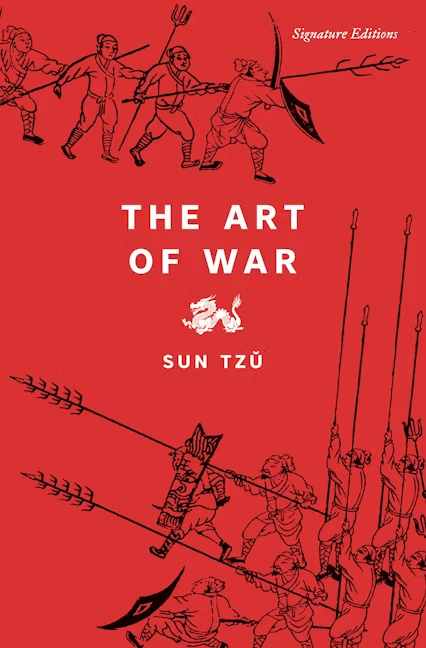
Olivia: The first is The Art of War by Sun Tzu.
Leon: Why that book?
Olivia: Well, let me make sure I explain this clearly. The Art of War was written by Sun Tzu, a general during a time when strategy, knowledge, and wisdom were passed down through family lineages. These lineages collected techniques for various disciplines—agriculture, smithing, and so on—and handed them down through generations.
Sun Tzu’s insights weren’t just his own but the culmination of wisdom from multiple generations. His strategies were successful enough that they were preserved and shared, and that’s what makes the book so valuable. It’s not just about war; it’s a guide to strategy and understanding the world around you.
I think longevity is valuable because it can serve as a testament to something enduring—though there’s a better way to say it, I can only think of it now as a “healthy social lifestyle.” The Art of War was written from a cultural perspective that understood both the necessity of preparation for war and the value of avoiding war through strategy.
What I appreciate about this is that, while it offers advice on conflict, its underlying focus is on avoiding conflict and maintaining stability through strategy.
Leon: But it’s a book about war, written for generals. Why was it useful for you?
Olivia: Because the same rules apply to everyday life. The same rules apply to interacting with others and maintaining responsibility for one another as people.
Leon: Responsibility while also—?
Olivia: Not being offensive isn’t quite right.
Leon: Say whatever is on your mind.
Olivia: It’s practical. It’s so practical and efficient. Practicality and efficiency are the only ways I can navigate social situations effectively and accurately.
Leon: That’s fantastic.
Olivia: It’s hard being a person. I made a note that I really liked: this book plays to the strengths of autistic individuals. It’s a handbook of rules on how to be a decent person, drawn from a collection of wisdom that has endured for centuries. That’s valuable.
Leon: Fair enough.
Olivia: I think it also helps navigate the hypocrisy you sometimes see in society. That’s a topic the book touches on as well.
Leon: Is that a good summary?
Olivia: Yes, I think so.
Leon: Great. Let’s move on.
Olivia: The next book is The Book of Proverbs.

Olivia: I chose it because, just as The Art of War helped me understand practical and efficient methods of being a human being, Proverbs helps me understand the structure and expectations of my own culture. It’s definitely broad enough to encompass U.S. society and structure, but I think its lessons can also apply to Western culture more generally.
Leon: How so?
Olivia: It helps you understand the rules of the society you live in—the basis for their moral justification for those rules. That, in turn, helps you navigate them more effectively.
In my state, the Bible is to be taught in schools, so we are preemptively teaching it at home. My children’s Bible explained what the book of Proverbs is for, and I found its reasoning very apt for our purposes too.
It says that Proverbs is written by King Solomon (the wisest man to ever live, according to some religious traditions) for everyone, even for people who do not believe in God, because they can use its good advice. It includes advice on making friends, living in a family, managing money, doing what’s right, caring for poor people, and many other important things.
Leon: And?
Olivia: And, this encapsulates so much of what I’m talking about. To be clear, it’s not the moral message I’m advocating for, but rather its practical advice on navigating the western world. It’s a foundation for many social rules, although that’s probably specific to where I’m from.
Leon: And the next book?
Olivia: Number three is Notes from Underground by Dostoyevsky.

Leon: Why that one?
Olivia: So, we’ve had two books of wisdom, and now we’re shifting slightly. While this book is very introspective, it’s also deeply impactful. For me, Notes from Underground taught me how to look at myself in the mirror, and I think that’s a vital quality for any human being, but especially for autistic people.
Leon: How so?
Olivia: Well, I think autistic people can experience a certain degree of self-righteousness. The DSM even lists a heightened sense of justice as a characteristic—not a criterion, but part of the broader description of autism. This book helps with that. It’s uncomfortable, but in a good way.
It forces you to confront difficult emotions and reactions, particularly in social situations. These are often more challenging for autistic people. The book offers an opportunity to step outside of yourself and examine those feelings from a different perspective, which I find incredibly valuable.
For me, it provided a platform for having tough conversations with myself. I reenact or imagine scenes in my head to process situations. We’ve talked about that before. Notes from Underground—especially scenes like the ones in the restaurant—gave me the framework to create and work through those conversations. It’s like it gives you the bones to do the work yourself.
Leon: Let’s continue.
Olivia: My third book is Sapiens: A Brief History of Humankind.

Leon: Why did you choose this book?
Olivia: I chose it because I started discussing some of its concepts with my best friend, who had read it. He said, “Liv, I think you’ll like this book.” I read it and told him, “You’re exactly right.”
It gave me perspective. For me, it’s a way to zoom out and see the larger context. Being autistic can be overwhelming, and learning to zoom out can help with some of the anxieties that come with it.
Leon: How does the book help you zoom out? Can you give an example?
Olivia: It’s a way of looking at the history of humankind—how humans came to be. It offers a perspective on what a human being actually is, not who you are or why you exist. It’s not about having an existential crisis; it’s about understanding what a human being is in the broader context.
The book starts by discussing Earth as a solid rock, then gaining water, moving on to prokaryotes, eukaryotes, and so on. That timeline makes you feel very small, but in a good way. It’s humbling and comforting to think of yourself as a grain of sand in a vast world.
Leon: A grain of sand—beautiful imagery. What’s the last book you have for us today?
Olivia: I have two last ones.
Leon: Let’s hear them.
Olivia: The first is a collection of essays by James Baldwin.
Leon: What’s it called?
Olivia: It’s just a general collection of essays, but I have specific recommendations. I’d suggest The Devil Finds Work and Notes of a Native Son.

Leon: Why James Baldwin?
Olivia: Baldwin himself is more important than any one book. His works are profoundly human. Reading his essays is like holding a mirror up to humanity. They capture so much about life, identity, and social struggles. It’s similar to the experience of reading The Unbearable Lightness of Being—the depth, the exploration of what it means to be human.
I haven’t read much more from Kundera than The Unbearable Lightness of Being, but every single thing I’ve read by James Baldwin makes me feel alive.
It’s hard to describe. When I read Baldwin and hear his voice, it feels like he’s so clearly present. I don’t know what the translation of that feeling is. I don’t know how else to explain it—it’s the opposite of loneliness. There are a few authors like that for me. When you read them, whatever loneliness you’ve felt disappears. It’s the complete opposite.
I think that’s significant because autistic people often struggle with loneliness. That hasn’t just been my experience; when I talk to other autistic people, loneliness comes up as a recurring theme. That’s why Baldwin is so important to me.
Leon: That’s a beautiful sentiment. You mentioned Temple Grandin as the last author on your list.
Olivia: Yes, Temple Grandin. When I read her, it’s such a satisfying experience. Normally, when I read a book, there are always things the author mentions that I get curious about, things I want to know more about, but they’re unimportant to the author.
With Temple Grandin, I never have to keep Wikipedia open because she anticipates all the questions I might have and answers them in the text. It’s such a joy to read her work.

Leon: What makes her writing stand out to you?
Olivia: Beyond the satisfaction of her thoroughness, she offers really valuable insights into autism and thought processes. She helped me understand that even autistic people think differently from one another—like visual thinking, for example. Her work is not just informative but also deeply enjoyable. I really like her writing.
And I have an honorary mention. My honorary mention goes to you.
Leon: Oh?
Olivia: And I think I have a favorite of your papers, though I never remember titles very well. Let me see… ah, The Autistic Pseudo-Signifier: Imaginary Dialectization of Signs in the Clinic of Autism. That’s the one. I have lots of notes on it.
Leon: Thank you—that’s very kind of you.
Olivia: I recommend you because you navigate theory and autism with an interest in making the two connect meaningfully. I think that helps your writing become more useful. Your interest in autism adds real value to your work.
Leon: I appreciate that very much.
Olivia: You’re welcome.
Leon: Before we conclude, is there anything you’d like to say to the readers of this interview as they prepare to explore these books?
Olivia: If you do nothing else, find poetry.
Leon: Yes poetry!
Olivia: Read poetry. You don’t even have to buy anything—you can find it free online. Poetry is an easy, free way to get most of the benefits these books offer. It’s less structured, but it teaches you how to be human.
Look at art. Listen to music. Find something that speaks to you. Poetry always helps. It always helps you learn how to be human.
What books have helped you learn what it means to be human? We’d love to hear about the stories, insights, or wisdom that have made a difference in your life.

 Leon Brenner