Marty Supreme (2026) is a contemporary film that provides a tightly organized fiction for thinking the divided subject, and it does so by staging, with unusual clarity, the Oedipal problem in its Lacanian form: the subject’s attempt to resolve the enigma of the mother’s desire, the failure or weakness of the paternal function, and the Law through which enjoyment must be mediated.
Spoilers ahead.
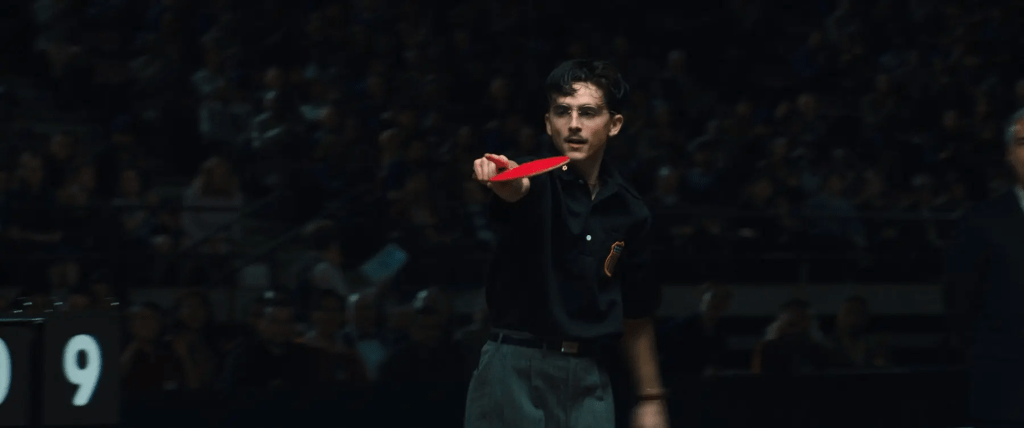
Set in the early 1950s, Marty Supreme follows Marty Mauser, a fast-talking Jewish New Yorker who works in a shoe store while obsessively pursuing international table-tennis glory. After a sexual encounter with his childhood friend Rachel leaves her pregnant, Marty steals money to finance a trip to London, where he barges his way into elite circles, begins an affair with the aging actress Kay Stone, and suffers a humiliating defeat at the hands of the Japanese champion Koto Endo. The loss returns him to New York disgraced, indebted, and increasingly frantic. What follows is a manic chain of hustles, evasions, erotic detours, criminal entanglements, and failed schemes through which Marty tries to secure money and passage to Japan for a rematch. In Japan he discovers that official reinstatement is closed to him, turning a staged exhibition into the only possible site of reckoning. He defeats Endo there in an unofficial but emotionally decisive match, then returns to the hospital where Rachel has given birth to his child. This is where the film.
Marty is introduced from the outset as a young man full of libido, a creature of oral appetite, inhaling the world through his mouth. He takes in what pleases him and spits out whatever might frustrate. Freud’s distinction between the oral and anal organizations is helpful here. Before social law intervenes in the anal stage, the world is sorted according to pleasure and unpleasure, incorporation and expulsion revolving the mouth. Marty inhabits precisely such a world. He grabs, seduces, steals, boasts, lies, and runs with the conviction that whatever serves the ego’s satisfaction may be seized, while whatever obstructs it may be discarded. The film’s manic pace expresses that libidinal structure. Marty does not simply move quickly; he consumes the world in a sequence of bursts initiated by the passionate kissing scene opening the movie.
Yet the film is not portraying Marty as a subject that is truly without limits. On the contrary, prohibition is everywhere at stake for him. This is why Marty is best understood as a neurotic, more specifically as an obsessional subject, rather than as a purely psychopathic one. The obsessional does not live beyond the Law; he circles it, provokes it, delays before it, and tries to secure desire by never quite arriving at its decisive point. Marty’s frenzy has exactly that function. He appears active at every moment, but much of that activity is a machine of postponement. He multiplies side routes, schemes, humiliations, and detours that keep the object in play while preserving the fantasy that it remains attainable. Like an analysand that keeps on speaking without gaps for a full 45-minute session, Marty’s restlessness protects him from the desire of the Other.
The key to this lies in the maternal domain. From the outset, Marty’s relation to his mother is marked by distress. Her presence is overbearing, almost persecutory. He avoids the home, escapes domestic space, and will even flee the police in order not to remain under that roof. The point here is not simple adolescent rebellion. Marty behaves like a subject for whom maternal proximity is intolerable. In Lacanian terms, he remains too exposed to the question of the (m)Other’s desire up to a point where the incestuous prohibition makes it unbearable. The child asks, in one way or another: what does the mother want, and can I be it for her? That question opens the Oedipal drama. The child first tries to answer it on the imaginary level, by becoming the object that would fill the mother’s lack.
Marty’s attempts is to seek that object elsewhere. He refuses the maternal enclosure, but he does not yet consent to lack. Instead he tries to find, in the world, the excluded sum of jouissance that would compensate for the prohibition of incest. If he cannot bear to receive it from his mother, he will attempt to do so in the Other. The championship becomes the privileged site of that search. The world title in table tennis is not a mere career objective for him. It is elevated into an absolute object. This is why ordinary recognitions leave him untouched. The shoe-store promotion has no weight. Social advancement in any modest form does not speak to him. Marty wants the true object, the one that would settle the question once and for all and would make him supreme.
Here the logic of the objet petit a comes into view. The object-cause of desire is not a worldly thing available for exchange; it is what sets desire in motion by remaining unattainable as such. Marty keeps searching for this object among earthly objects, as though it might be embodied in the championship, in money, in prestige, in travel, in women. This is why nothing works. Each concrete object is forced to carry more than it can bear. Desire therefore starts again, with renewed force, at every failure. The obsessional economy feeds on that failure. It preserves the object by ensuring that no actual attainment will ever coincide with the sublime Thing fantasized.

The film’s opening conjunction of sex and fertilization is crucial in this respect. Rachel’s pregnancy anchors the narrative from the beginning. Marty’s libido immediately produces a consequence that he cannot symbolize. He wants enjoyment without remainder. Rachel returns the remainder to him in embodied form. The child is there from the outset as the sign that desire is tied to the body’s decay. This is what Marty tries to flee. Rachel belongs to the side of consequence. Her pregnancy exposes the limit of Marty’s oral world, because the pleasure principle alone cannot absorb what has been set in motion. But this will be resolved later in the film.
The absence of the father is another one of the film’s quiet framing themes. The father is absent as an effective function. Rachel’s mention of his dying underscores the point: paternity enters the film as something already failing. For Lacan, this matters more than biological presence. The father is a signifier, the Name-of-the-Father, and his efficacy depends on whether he operates as a limit to the Desire of the Mother. Where that metaphor is deficient, the child remains too directly subjected to maternal desire and must improvise other ways of constructing a boundary. Marty’s life is full of such improvisations. He lives by “small paths,” by cunning routes, by side doors and hustles, because the “grand route” of symbolic mediation does not seem available to him in any secure form.
The London sequence concentrates these dynamics. Marty leaves New York to seek the object on the world stage, and there he enters a field structured by substitutes for both mother and father. Kay Stone is the maternal object in elevated form: glamorous, older, desirable, publicly visible, touched by prestige. Marty tries to seduce her immediately. Through Kay, the maternal object is displaced into fantasy, performance, and celebrity away from the explicit incestual fantasy. Milton Rockwell, her husband, occupies the opposite pole. He is the father-substitute: older, wealthy, powerful, attached to Kay, and capable of granting or withholding access. Marty enters their orbit as though reenacting the Oedipal triangle at a higher social register. He sleeps with the maternal substitute and provokes the paternal one. He seeks to possess one and humiliate or outwit the other.
The postwar dimension is inserted at this point. Rockwell speaks from the position of paternal loss, invoking his dead son in the war and converting that loss into social authority. His pens, with their obvious phallic valence, reinforce this point. Koto Endo, on the other side, carries the mark of wartime devastation in another way. Quiet, controlled, and deafened by the bombs, he stands opposite Marty’s overfull American energy. Endo appears as a subject marked by limit, while Marty still behaves as though limit can be shouted down, outplayed, or bypassed. Rockwell and Endo thus bracket Marty’s fantasy of mastery with two different masculine figures of historical and symbolic loss.
Marty’s defeat by Endo forces him into a real encounter with castration. The rival occupies the place Marty had reserved for himself. Marty’s immediate explanation is that the racket is to blame. This is a classic neurotic displacement. Instead of admitting that the fantasy of supremacy has met a limit, the subject imagines that the rival held the missing supplement. Marty can therefore preserve the belief that the true object still exists and can still be won. The defeat humiliates him, but it does not yet alter his structure. We might say that it intensifies it.
This becomes clear in the long middle movement of the film. Marty hustles, steals, seduces Kay again, becomes entangled with criminals, chases money, loses objects, recovers objects, and pursues the trip to Japan through an escalating chain of absurd and violent detours. The dog, the necklace, the hustles, the sponsorship, the branded ping-pong balls: all these objects circulate as substitutes. None brings him closer to the thing he wants because the thing he wants is not of the same order. The obsessional subject preserves the absolute object through this very proliferation of lesser objects. Desire remains alive because the decisive encounter is constantly displaced. The signified keep sliding down the chain of signifiers.

Rockwell’s punishment is a turning point in the film. Marty finally secures his passage to Japan by accepting a public beating with the paddle. This is a brutal and humiliating scene. The father-substitute punishes the child. Access to the desired destination is purchased through submission to paternal humiliation. The scene is all the more striking because Rockwell does not function as a noble bearer of the Law. He embodies a degraded paternal function, obscene and exploitative. Marty reaches Japan only by passing under the signifier of this father’s punishment. The Law appears for him in distorted form, but it appears all the same.
Japan then becomes the site where his obsessional deferral breaks. He is refused entry into the official tournament. The institution bars him, which is to say, he is rendered a subject under the bar: $. He is allowed only the fake exhibition in the sponsored spectacle. His eventual demand for a real rematch with Endo comes at the point where the available exits have narrowed and humiliation has become intolerable. He acts in extremis. This is why the moment carries force. It is less the triumph of sovereign will than the collapse of deferral under pressure.
The victory that follows matters, but its meaning lies elsewhere than in redemption. Marty beats Endo. He receives the acknowledgment he has wanted. For the first time, the racket of his speech gives way to silence and tears. Yet the object has arrived in compromised form. The title does not simply install him in wholeness. And maybe the point is that that is enough. What collapses at this point is the fantasy that victory could ever do what he demanded of it. The supreme object has been reached and found insufficient. This might be the film’s harshest lesson. One that signals that the worst thing that could happen to the neurotic is to get what they want.
But the narrative continues because the Oedipal problem has not yet been closed. Rachel gives birth. Marty goes to the hospital after the match and stands before his child. Here the film resolves its central line with a certain bluntness. Marty has spent the entire narrative trying to be the object that would complete the Other. The child does not mirror his grandiosity back to him. Before the nursery glass, Marty confronts the possibility of occupying the position of a father rather than continuing to search for the place of the Marty Supreme. His coordinates within the Oedipal struggle are reconfigured.
This ending should remain somewhat ambivalent. The film gives the scene a degree of reconciliation that is perhaps more generous than the preceding structure would suggest. One could imagine a harsher ending, one in which Marty’s drive continues past victory into another circuit of repetition. Yet the film chooses another path. It pushes toward a resolution in which the acceptance of lack becomes the condition for a more ordinary relation to desire. In that sense the conclusion is indeed somewhat reactionary, though also clinically legible. Marty does not emerge cured, whole, or happy. He appears instead on the threshold of a different suffering, one less governed by the fantasy of absolute satisfaction. If one remains close to Freud here, one might say: still suffering but perhaps suffering in a less dramatic way.
This is where Marty Supreme earns comparison, however modest, with the kinds of artistic structures Lacan valued. The film does not merely depict a character with problems. It arranges a chain of signifiers—mother, absent father, championship, Kay, Rockwell, Endo, paddle, pregnancy, child—in such a way that the subject’s division becomes legible through its movement. Marty wants to be supreme because he wants a world without lack. The film subjects that fantasy to defeat and, finally, to symbolic repositioning. Its deepest claim is simple. There is no earthly object capable of resolving the Oedipal wound. The subject either continues to search for it in ever more frantic substitutions, or begins, painfully, to consent to the Law that bars it.


 Leon Brenner