Sorry, Baby (2025) is a film that resists rigid definitions. One then could call it a queer film, though it is important to nuance this term for the sake of our discussion. On the one hand, the film certainly brushes against recognizable coordinates of queer life. Its central relationship between Agnes and Lydie is deeply intimate—the latter also marries a woman and starts a family with her—while Agnes herself appears to occupy a relation to gender and desire not fully determined by conventional forms. Yet the film’s queerness lies more fundamentally in its refusal of closure, in the way it opens experience onto zones of uncertainty that cannot be brought under a final interpretive rule. Like Eve Kosofsky Sedgwick describes in Tendencies (1993): it offers an open mesh of possibilities, gaps, overlaps, dissonances, resonances, lapses, and excesses of meaning that cannot be stabilized into a single, monolithic signification (p. 8). In this sense, its queerness also begins to approach a more distinctly psychoanalytic truism, which states that the subject emerges not as a stable identity but as something constituted through division.
But the film is not only queer. It is also feminine. And here the term, when taken in the Lacanian sense, must be carefully detached from any immediate appeal to gender politics, sexual identity, or biology. The feminine, in the Lacanian sense elaborated in Seminar XX, does not refer to a particular sex, gender, or anything we might think of as a complement to masculinity. In Lacan’s psychoanalysis, the feminine refers to a particular mode of subjectivity not wholly captured by the domain of clear-cut signification, even while it remains within it. Feminine enjoyment—which is the object of interest for any type of analysis—emerges, not in the things that bring meaning to our life, but at the threshold of language, in that gray zone where meaning begins to fray and where the body is affected not strictly by what is said, but by the fact of signification itself. Sorry, Baby is feminine in precisely this sense. It offers no verdict, no moralized lesson, no stable coordinates by which the viewer is told what to think. It does not reduce its material to a case, a slogan, or a polemic that we might identify with and, therefore, enjoy. Instead, it accompanies the opacity of a singular experience, exposing something of the gray zone of, what Lacan calls, the sexual non-rapport: the place where the subject’s relation to desire, to speech, and to the Other can no longer be fully secured.

This is evident already in the film’s structure. It opens not with the event situated at the core of the film, but years later, in the ordinariness of a life that has continued without ever entirely leaving that event behind. Agnes is now a literature professor at the same small New England college where she was once a graduate student. She still lives in the same house. She sees her awkwardly sweet neighbor Gavin. She has a cat. Her best friend and former roommate, Lydie, comes to visit, and their reunion initially unfolds in a banter full of intimacy, wit, and quiet domesticity. The two lounge together, gossip, tease one another, and enjoy a close friendship which requires—and receives—no explanation. When Lydie reveals that she is pregnant, the disclosure brings into view the divergence of their temporalities. Lydie’s life has moved forward, to another city, into marriage and family, whereas Agnes seems held within a different relation to time: not simply immobilized, but suspended in a life that has undeniably continued without ever having fully passed beyond what happened to her. The film begins there, in that peculiar atmosphere where the ordinary has already been marked by a past it cannot completely metabolize. Only later, after a dinner with old colleagues stirs dormant tensions, does the narrative move back into the first sequence which reveals the event around which the present has silently organized itself.
This sequence reveals Agnes as an exceptionally gifted graduate student, recognized by her peers and, more significantly, singled out by her supervisor, Preston Decker, as a rare intellectual and literary talent. There is an implicit element of seduction in this attention, yet the film is careful not to render that seduction in advance as a fully legible script. When Lydie asks whether Agnes would ever pursue him romantically, Agnes remains uncertain. She occupies neither a clear refusal nor an avowal, but a zone of hesitation whose indeterminacy will later become central to the traumatic force of what occurs. Eventually Decker invites Agnes to his house under the pretense of discussing her work further. What happens there becomes the center of the film while also remaining visually withheld. The assault is never shown. Instead, the camera stays outside the house as afternoon fades into evening and then into night. Time dilates and the shot itself becomes unbearable. When Agnes finally emerges, hurriedly putting on her boots while Decker remains in the doorway, the violence of the scene is conveyed without representation in the conventional sense. The camera follows her back to her car with a detached, dissociated reserve. Later, when she returns home to Lydie, her first displaced utterance is that her “pants are broken.” This formulation expresses her psychic disorganization: a statement at once absurd, comic, and devastating—the object slips underneath the utterance.
When Agnes later recounts the event to Lydie in the bathtub (a point of entry into the temporality of trauma, as well as, we shall see, the point of exit), the film portrays the scene in her words. Agnes describes that Decker put his hand in her pants, that she kissed him so he would stop, that he put on a film, that she stayed. The facts are clear enough. But the psychic reality of the event is not reducible to those facts alone. Agnes’s distress inheres in the way the experience fractures her ability to know her own position within it. Did she acquiesce? Did she freeze? Did she submit strategically in order to stop something worse? Why did she stay? Why did she not leave? The film never validates these questions as juridically meaningful doubts about whether an assault took place, yet it insists on their psychic importance because they are precisely the kinds of questions trauma forces upon the subject. What continues to work within Agnes afterward is therefore not only the fact of external violence, but the ambiguity through which that violence becomes subjectively lodged and repeatedly returns.
The question the film poses is therefore not simply how sexual violence occurs, but how one remains a “whole” person after it does. Yet even the term trauma must be handled carefully here, because Sorry, Baby is rigorous in showing that the traumatic is not reducible either to the event or to an immediately available interpretation. Trauma emerges, rather, from the split that opens in the subject’s relation to what has occurred. This is what Freud’s early writing helps clarify. In “The Neuro-Psychoses of Defence” (1894) and Studies on Hysteria (1895), he stresses that what becomes traumatic is not simply an externally bad event as such, but the emergence of an “incompatible idea,” an experience whose affective force cannot be reconciled with the ego’s existing coordinates. Trauma, for Freud, does not name an external violence, but the internal failure of subjective integration. The event leaves its trace because it cannot be fully associated, processed, or abreacted; it remains psychically active because the subject cannot establish a stable relation to it. Its force lies in the split it opens in one’s experience.
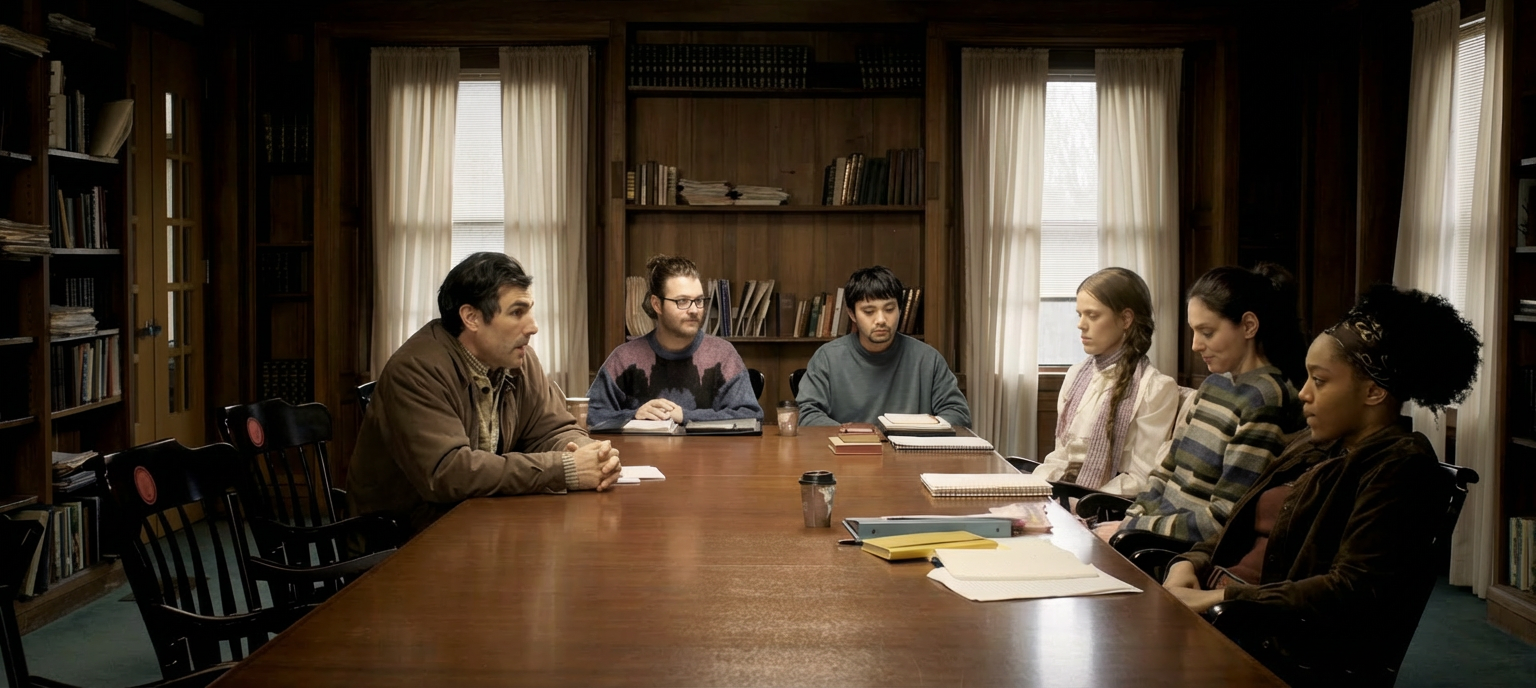
The next sequence follows a series of attempts to impose an interpretation from the outside. At the hospital she is met by a doctor whose manner is procedural, tonally wrong, and almost grotesquely insensitive. The university administrators are equally inadequate, less through overt cruelty than through their inability to receive what has happened outside the dead language of academic procedures (which becomes even more ridiculous when they keep on stressing that they understand her because “they are women”). Even later, in a seemingly unrelated scene of jury duty, the state reappears as a machine of forced articulation, demanding that she matches a verdict to Decker. She wants Decker not to do this again. She does not want him jailed because he has a child. She does not want to press charges. None of these positions yields a coherent public script. The violence of these scenes does not lie simply in bureaucratic indifference, though that is certainly present. More importantly, it lies in the demand that Agnes render in exact symbolic terms something whose traumatic force derives precisely from its resistance to such symbolization. This incoherence is the very shape of her subjective division.
That division persists in forms both obvious and displaced. It returns in fear, in sounds outside the house, in the charged presence of boots and doors, in the atmosphere of rooms and offices. It returns in professional life, where Agnes’s success is inseparable from the site of her violation. Years later, when she is hired to replace Decker, the institution praises her in language uncannily continuous with his own, calling her “extraordinary,” repeating the signifier with which he had once marked her talent. The promotion is also a contamination. Was she chosen because she is brilliant, because the institution feels guilty, because Decker’s prior recognition of her skills? Agnes cannot know where her merit ends and the trace of the event begins.
This is why the later return of Natasha is so important. Natasha initially appears as a comic irritant, a resentful colleague whose abrasiveness and envy make her easy to dismiss. Yet the film gradually grants her a more disruptive function. Natasha visits Agnes in Decker’s former office and discloses that she too had sex with him, and that it did nothing for her professionally. This revelation destabilizes Agnes in a particularly acute way. Until that moment, she has at least been able to organize the event as a singular assault that determined her relation to Decker and perhaps even shaped her institutional place. Natasha’s disclosure tears open that provisional certainty. If he slept with many students, if his desire circulated promiscuously through the department, then what precisely was Agnes for him? Was she genuinely valued? Was her talent real to him, or merely one more instrument in the economy of his predation? The point is not that the assault becomes less real. It is that Agnes’s position within the Other’s desire becomes newly opaque.

This is where Lacan’s account of anxiety in Seminar X comes in handy. Anxiety, for Lacan, arises from the subject’s confrontation with the object as cause of the Other’s desire. One becomes anxious when one can no longer secure what one is for the Other. Lacan famously renders this with the image of the praying mantis: one stands before the giant insect wearing a mask one cannot see, uncertain whether one appears as a partner, a rival, or prey. The horror lies not merely in the fear of death but in not knowing what kind of object one has become within the Other’s field. This is precisely the structure into which Agnes is thrown. Natasha’s revelation intensifies this uncertainty about her place vis-à-vis the Other’s desire, because it deprives Agnes even of the fragile fantasy that the event can be secured under one stable meaning. The result is anxiety in the strict sense: not fear of a known object, but the unbearable nearness of not knowing what object one has been.
It is no accident, then, that panic peaks only after this later destabilization. Driving alone, Agnes has a panic attack and pulls into the parking lot of a seasonal sandwich shop. The owner, Pete, first approaches to tell her she cannot park there, but upon seeing her distress immediately shifts into care. He coaches her breathing, calms her down, and then sits with her over food while she explains that she is still trying to get over a bad thing that happened years earlier. The scene is one of the film’s most consequential because it introduces, however briefly, the function of listening. Pete is a man, but not one who approaches Agnes under the sign of demand. He mentions that his son also has panic attacks. He offers no mastery, no interpretation, no coercive comfort. In this sense the scene reintroduces masculinity in a castrated form: masculinity divested of predatory certainty, of phallic omnipotence. For that reason, the film exceeds any simple politics of anti-masculine denunciation. It is not interested in condemning men as such. It is interested instead in differentiating forms of relating.

The transformation of Agnes’s position becomes still more legible in the scene with the mouse. One night her cat brings a dying mouse into bed. Agnes sees that the animal is suffering and decides to kill it. She reaches for a book and uses it to smash the mouse while saying sorry. The book is A Winter in Time, written by Decker. The symbolic density of the moment is extraordinary. Agnes takes up the object through which Decker’s cultural authority has been materialized, the literary work that stands as the polished product of his intellect and prestige, and uses it as an instrument of violence. Yet this violence is not gratuitous. It is done in the name of mercy. The scene therefore condenses aggression and care, destruction and ethical necessity, revenge and pity. Agnes is no longer positioned only as the recipient of violence. She acts in the Lacanian sense. More precisely, she acts from within the very ambiguity that has tormented her. This act is overdetermined. Through it, she takes up something of Decker’s position, of violence, subjection, perhaps vengeance, but also of mercy and care. It marks the point at which she separates herself from the compulsive need to produce a final, coherent meaning for what happened. It stages the point at which Agnes ceases trying to disentangle herself from division and instead assumes it.
Her immediate turn to Gavin after this scene is therefore important. She runs to his house and loudly asks him to have sex with her. Earlier their encounters had been marked by hesitation, awkwardness, and a certain deadened uncertainty; desire never seemed fully available within her. Now Agnes approaches him and the love scene leaves doubt of her pleasure. This is not because sex with a man becomes redemptive, nor because heterosexuality suddenly resolves anything. Rather, it signals a shift in her relation to desire itself: a problem that many analysands struggle with, inside and outside their bed. After their passionate encounter, Gavin joins Agnes in the bathtub, asking softly whether he may sit with her. In this site of entry (the bathtub) he speaks about family and children. Nothing in these questions is threatening; if anything, their very hesitancy gives them an almost childlike gentleness. Once again Agnes encounters a masculinity stripped of menace, one that does not place her in the impossible position of deciphering what she is for the Other. This marks one more turn of the screw in Agnes’s movement toward a different position.

The film’s final section with Lydie, her wife, and the baby extends this reconfiguration. Lydie returns now as part of a family unit, carrying with her a child who embodies life and the risks that it harbors. Lydie and her wife consider leaving the baby with Agnes for a short while. There is hesitation, a sense that Agnes may not be entirely fit, but they go. Agnes is left alone holding the child. Agnes, who for so much of the film has occupied the position of the one to whom care is extended, is now entrusted with vulnerability itself.
Her final words to the baby crystallize the entire film: “I’m sorry that bad things are going to happen to you. I hope they don’t. But sometimes bad stuff just happens. That’s why I feel bad for you in a way. You’re alive and you don’t know that yet. But I can still listen and not be scared. So that’s good. Or that’s something at least.” Nothing could be further from therapeutic cliché. Agnes offers no promise that pain can be prevented, no assurance that life can be organized to avoid suffering, no fantasy of final repair. What she offers instead is a minimal ethics of listening: the ability to remain present before another’s vulnerability without retreating from it in fear. This is why the ending is so important. It does not overcome ambiguity. It changes Agnes’s relation to it. She no longer has to extract a final meaning from what happened to go on. She can bear the fact that bad things happen in life and that no one is exempt from contingency.

At its core, then, Sorry, Baby is a film about the banality of trauma. Not banality in the sense of triviality, but in the sense that what most radically splits the subject often emerges from gray and ordinary conditions. Decker is not rendered as a monstrous aberration. The hospital is not staffed by villains in any grandiose sense. The university administrators are not sadists. This is what makes the trauma so devastating. It does not arrive already packaged as the clearly signified evil against which the subject could simply take a stable stand. The event becomes traumatic because it splits Agnes in a way that is unpredictable and too much to bear, and because that split cannot be mended by any ready-made signifier.
This is why the film is queer and feminine in the strongest sense. It remains with what cannot be made fully to signify. It dwells at the threshold where language fails to organize experience into stable meaning, and where subjectivity nevertheless persists. If there is an ethics here, it is a gray one, stripped of a purified moralism. Bad things happen to everyone. One cannot finally prepare for them, and one cannot live by pretending otherwise. What one can do, perhaps, is become capable of listening carefully, of not being scared by another’s pain. That, the film insists, is not everything. But it is something.

 Leon Brenner