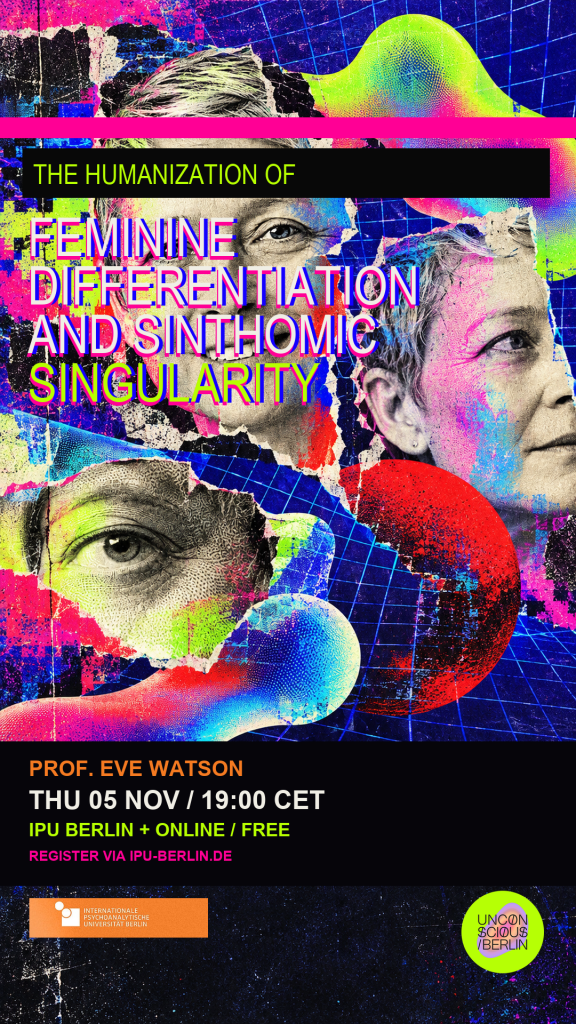
Join us for a free public lecture on 5 November.
Dear readers,
This November, I am happy to welcome Eve Watson to Unconscious Berlin for a series of lectures. I would especially like to invite you to her open lecture at the International Psychoanalytic University Berlin on Thursday, 5 November. You can join us in person or online, and admission is free.
Let me tell you a little about Eve. She is a psychoanalyst, clinical supervisor, and writer based in Dublin, where she is also academic director of the Freud Lacan institute. She writes on sexuality and film, alongside her work in psychoanalytic practice and training. In Clinical Encounters in Sexuality: Psychoanalytic Practice and Queer Theory, which she co-edited with Noreen Giffney, practising analysts respond to essays by queer theorists. The contributors come from different psychoanalytic traditions and disagree on concepts that have consequences in the consulting room. What does an analyst hear when someone speaks about their sexuality? What have they already decided they know? The book asks how social attitudes towards sexuality enter the transference and the analyst’s response to it. Eve also co-edited Critical Essays on the Drive: Lacanian Theory and Practice with Dan Collins, the collection to which I contributed my chapter on the skin and the dermic drive.
Her public lecture in Berlin is titled The Humanization of Feminine Differentiation and Sinthomic Singularity. Eve begins from a contradiction: contemporary discourse celebrates individuality, while market capitalism treats us as equivalent consumers. She asks how feminine differentiation troubles this equivalence, and examines the misogynistic and dehumanizing backlash against the feminine, gender non-conformity, and transness.
There is something peculiar about being encouraged to be different and then encountering hostility when one’s difference becomes difficult for others to accommodate. I am interested in what psychoanalysis can say about that hostility. What is being defended when another person’s sexuality is experienced as a threat? The question also concerns the concepts with which analysts approach sexuality in their own practice.
The word feminine needs some nuance here. In its Lacanian use, it cannot simply be assigned to a biological sex or read off a person’s gender identity. It concerns a subject’s relation to enjoyment. This distinction has clinical value: knowing the name by which someone identifies does not tell an analyst how that person enjoys or suffers.
Eve approaches this clinical problem through Lacan’s notion of the sinthome: a singular invention through which a subject can delimit jouissance, the enjoyment that can insist beyond pleasure, and find a way of living with their unconscious. Such an invention may remain difficult to explain in the terms available to others. The analyst has to listen for how it works for this particular subject.
Be that as it may, it’s important to acknowledge that psychoanalysis has its own anxieties about gender non-conformity, and Eve asks us to examine them in her lecture. This is the part of her argument I would particularly like us to discuss following the session. An analyst can be attached to a theoretical account of sexuality and hear everything through it. A person then has to fit the account before their speech can be taken seriously. How does an analyst notice when their own knowledge has become an obstacle to listening?
I hope clinicians and students will join us, as well as those of you interested in sexuality and gender who would like to hear Eve speak. Here are the details for the open lecture:
The open lecture
Eve Watson — The Humanization of Feminine Differentiation and Sinthomic Singularity
- When: Thursday, 5 November 2026, at 19:00 CET
- Where: IPU Berlin, Lecture Hall 4, second floor, Alt-Moabit 91b, 10557 Berlin
- Attendance: In person and online
- Admission: Free; registration required
Register here through IPU Berlin.
Otherwise, you can contact me via Instagram and I can send you the link for participating online.
It would be lovely to see you there, whether in Berlin or joining us online.
Warm wishes,
Leon